01

AUGUST

2026

Offshore Equipment "Zero-Maintenance" Strategy: How to Select Ultra-Durable RF Connectors to Reduce Marine O&M Costs

1. The Hidden Pain Point of Offshore Operations: Why Enterprises Need a "Zero-Maintenance" Strategy

In the deployment of deep-sea shipping, unmanned maritime equipment, and offshore infrastructure, the initial hardware procurement and construction costs are merely the tip of the iceberg. When this equipment operates far from the coastline, the true commercial test emerges: How can you ensure the system operates continuously without interruption in extreme climates and high-salinity environments?

The Staggering Costs and Downtime Risks of Offshore Maintenance

In terrestrial or near-shore environments, rectifying RF communication anomalies usually only requires dispatching an engineer with spare parts. However, when an Unmanned Surface Vehicle (USV) or a deep-sea exploration buoy loses its signal in the middle of the Pacific Ocean, the cost of dispatching a specialized maintenance vessel and technical crew is often tens of thousands of times the value of the component itself. A standard RF connector failing due to salt spray corrosion can halt an entire exploration mission and expose multi-million-dollar equipment to catastrophic "loss of contact" risks.

From "Periodic Replacement" to "Fit-and-Forget": The Strategic Value

Facing exorbitant remote rescue costs, the maintenance strategy for modern maritime engineering has gradually shifted from "passive periodic replacement" to a maintenance model centered on "reliability and risk management." This is precisely why the fit-and-forget RF solution design philosophy has rapidly gained prominence.


Selecting ultra-durable RF connectors is not merely a technical upgrade in hardware protection ratings; it is a strategic commitment by enterprises to deliver "all-weather stable operations" to their clients. Through a one-time, high-spec implementation, companies can effectively eliminate maintenance requirements throughout the equipment's lifecycle, drastically reducing the Total Cost of Ownership (TCO) and enhancing the operational reliability of mission-critical systems.

2. Building the Ultimate Maintenance-Free Defense: Three Core Technologies to Withstand Extreme Marine Environments

Realizing a nearly maintenance-free vision relies on solid precision manufacturing capabilities, not just marketing slogans. Manufacturers must rigorously seal every microscopic gap and optimize material properties to prevent potential failures.

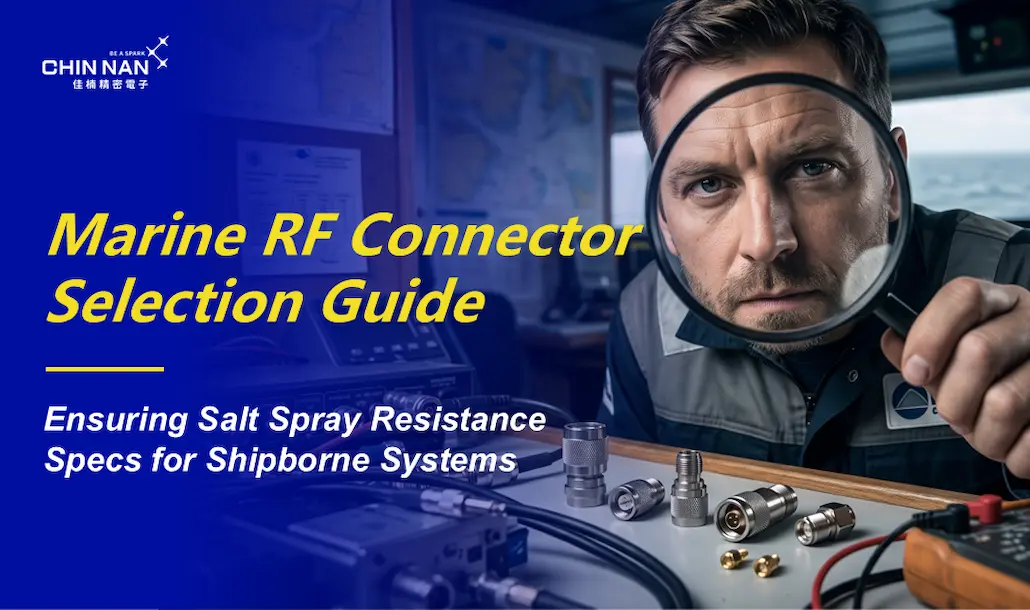
Breaking the 1000-Hour Salt Spray Test Limit: Weathering Standards for Longevity

Conventional IP67 waterproof connectors typically advertise a 48-hour salt spray test. While this may be sufficient for indoor cabin equipment, this defense line collapses quickly when exposed to unshielded decks and continuous ocean waves.


To guarantee the longevity of offshore equipment, high-end marine connectors must adopt a 1000-hour salt spray test standard, surpassing conventional military specifications. Enduring a thousand hours in high-concentration salt fog without producing red rust—while maintaining a non-degrading Voltage Standing Wave Ratio (VSWR)—is the first physical defense line ensuring the long-term stable operation of offshore antennas and radar equipment.

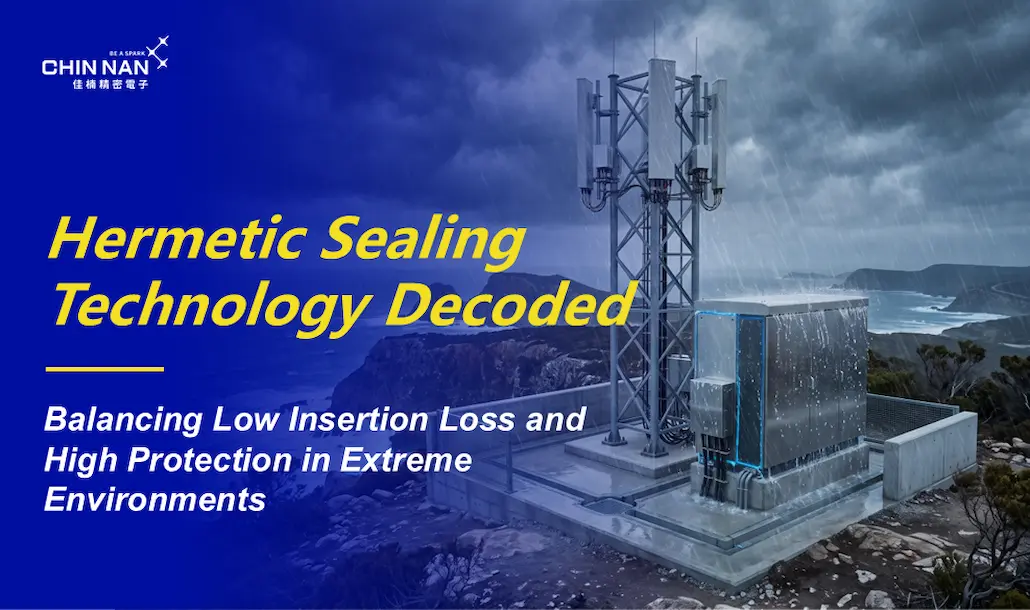
The Absolute Hermetic Barrier: Glass-to-Metal Sintering Technology

In environments alternating between deep-sea high pressure and severe temperature fluctuations, traditional rubber O-rings easily age and crack due to long-term thermal expansion and contraction, ultimately leading to moisture ingress.


To achieve "Fit-and-Forget" design goals, top-tier manufacturers utilize advanced Glass-to-Metal Sintering technology. Using a high-temperature furnace, inorganic glass preforms are melted to perfectly fuse with the metal housing and center pin at the "molecular level." This inorganic hermetic interface achieves an absolute vacuum leak rate of 1 × 10⁻⁸ cc/sec, completely eradicating the penetration of moisture, salt spray, and corrosive gases.

Eliminating Galvanic Corrosion and Aging: The Long-Term Protection of Tri-Metal Plating

Material selection dictates the endurance of anti-corrosion properties. Traditional Nickel-plated connectors easily trigger Galvanic Corrosion in saltwater. To achieve maintenance-free marine connectors, the current industry gold standard is Tri-Metal / White Bronze Plating.


Tri-Metal not only possesses outstanding anti-oxidation and wear-resistant capabilities, but more importantly, it is a non-magnetic material. It maintains excellent Low PIM (Passive Intermodulation) performance, ensuring that high-frequency communications remain crystal clear and interference-free even after years of exposure to harsh winds and relentless sun.

3. Key Application Scenarios for Zero-Maintenance RF Connectors

Combining strategic intent with top-tier protection technologies creates a massive commercial moat for the following maritime applications:

The Communication Lifeline for USVs and Deep-Sea Exploration Buoys

USVs and smart buoys operate in "fully unmanned" environments. Here, long life marine RF connectors are the critical foundational components maintaining satellite video transmission, telemetry data backhaul, and GPS positioning. A lost signal can lead to mission abortion or increased vehicle runaway risks. Therefore, these applications rely heavily on high-reliability RF connectors featuring self-locking anti-vibration mechanisms, superior hermeticity, corrosion resistance, and Fit-and-Forget designs to ensure long-term stability and reduce lifecycle maintenance needs.

Long-Term Automated Monitoring for Offshore Wind and Drilling Platforms

Scheduling maintenance for offshore infrastructure is not only logistically difficult but extremely dangerous. Whether transmitting sensor data within a wind turbine nacelle or facilitating microwave communications on an offshore substation, utilizing RF interfaces equipped with glass sintering and Tri-Metal protection ensures that communication nodes remain exempt from frequent replacements over a 20- to 30-year lifecycle.

Conclusion: Promising All-Weather Maritime Safety and Business Operations with High-Reliability Interconnects

In the unpredictable marine environment, the most stabilizing force often comes from the precision connectors hidden deep within the equipment, transmitting steadily day after day. Integrating ultra-durable connectors into offshore equipment doesn't just solve technical signal loss challenges for R&D engineers; it helps business owners drastically reduce the Total Cost of Ownership (TCO) and create superior operational resilience.


With over 60 years of deep-rooted precision machining expertise, Chin Nan Precision Electronics is dedicated to transforming cold metal into the most impenetrable defense line safeguarding maritime safety and corporate commitments.

CONSULT FORM

Consultation List

Review your selected inquiry items. You can switch inquiry topics using the buttons below.

DELETE

Delete this item

This action cannot be undone. Are you sure you want to delete?

Go Back

Confirm Deletion

SUBSCRIBE TO NEWSLETTER

Subscribe to Newsletter

歡迎訂閱佳楠電子報,我們將會與您分享最我們的最新動態、產品與技術訊息

Your Subscription Info

Go Back

Confirm Subscription

To unsubscribe, please

Click here

SUBSCRIBE SUCCESS

Successfully subscribed

您已成功訂閱佳楠電子報,敬啟期待我們的最新動態!

Return

CANCEL NEWSLETTER

Unsubscribe

請輸入您訂閱時所填寫的信箱,我們將協助您取消。

Your Subscription Info

Go Back

Confirm Cancellation

CANCEL SUCCESS

Subscription Cancelled

您的電子報已取消訂閱,期待您重新改變心意!

Return

WebsiteSearch

Site-wide Search

Search insights, key technologies, and products...

Search