28

JULY

2026

5G NTN Land-Air Integration: Hardware Challenges and Market Opportunities for Ground Gateway Stations

Following the completion of the 3GPP Release 17 specifications for NR-NTN and IoT-NTN, and the continuous enhancement of coverage, mobility, spectrum utilization, and system performance in Release 18, Non-Terrestrial Networks (NTN) are steadily transitioning from technical verification to practical deployment. NTN incorporates Low Earth Orbit (LEO), Medium Earth Orbit (MEO), Geostationary Orbit (GEO) satellites, and High Altitude Platform Systems (HAPS) into mobile communication architectures, extending terrestrial networks to oceans, mountains, islands, polar regions, and disaster zones where traditional base stations struggle to cover.


For telecommunications operators, satellite operators, and system integrators, achieving true land-air integration requires more than just satellite and air-interface technology. The ground segment—including NTN Gateways, antenna systems, RF front-ends, and baseband networks—is equally critical. Especially when utilizing high-capacity feeder links or Ka-band satellite links, the connectors, cable assemblies, waveguide transitions, and bulkhead interfaces within the ground station directly affect link loss, phase consistency, receive noise, and the overall Link Budget.

What are 5G NTN and gNodeB? How is Land-Air Integration Achieved?

Technical Evolution of Non-Terrestrial Networks (NTN)

Traditional satellite communications typically employ proprietary terminals, specific frequency bands, and closed network architectures. The significant value of 5G NTN lies in incorporating satellites or high-altitude platforms into 3GPP standardized networks, enabling mobile terminals, automotive equipment, and IoT devices to access non-terrestrial networks using suitable frequency bands, antenna capabilities, and network conditions.


It is important to note that "Direct-to-Device" or "Direct-to-Cell" does not imply that all existing smartphones can connect to all satellite systems. Terminals must still comply with relevant frequency bands, RF power, antenna capabilities, protocol versions, carrier networks, and regulatory requirements. Release 17 NR satellite access specifications primarily cover specific FR1-NTN bands, while Ka-band is more common for high-capacity satellite service links or feeder links. The actual architecture must be determined based on specific system design. NTN applications include maritime shipping, disaster response, smart logistics, remote area communications, energy facility monitoring, aviation communications, and unmanned vehicles. It complements terrestrial network coverage gaps but should not be described as a complete replacement; rather, it serves as an extension and supplement to terrestrial mobile networks.

The gNodeB as a Key Access Node in 5G NTN

In 5G NTN architectures, the gNodeB handles NR wireless access, base station protocol processing, and connectivity to the 5G Core Network, serving as a vital control node for terrestrial networks. Depending on satellite payload capabilities, NTN architectures are primarily categorized into two modes:

  • Transparent Payload: The satellite is responsible for reception, filtering, frequency conversion, power amplification, and retransmission of RF signals. It does not perform full base station baseband processing; thus, this is often called the "Bent-Pipe" architecture. Terminal signals are relayed by the satellite to the ground NTN Gateway, where the ground-based gNodeB completes wireless access protocols and core network processing.
  • Regenerative Payload: The satellite platform deploys partial or full base station functionality, capable of signal demodulation, decoding, re-encoding, and modulation, and may even integrate partial or full gNodeB functions. The ground NTN Gateway establishes a high-capacity backhaul link to the satellite via Feeder Link, connecting to the 5G Core Network.


Regardless of whether a transparent or regenerative architecture is used, ground NTN Gateways and related RF equipment must handle high-bandwidth, high-capacity, and high-reliability RF signal transmission. As some systems adopt Ku or Ka bands for Feeder Links, the insertion loss, return loss, phase stability, and environmental reliability of the RF interconnect system directly impact the overall Link Budget and system service quality.


What Environmental Challenges Do Outdoor NTN Ground Stations Face?

NTN Gateways or satellite ground stations may be deployed in coastal areas, high mountains, deserts, islands, polar regions, or unmanned remote sites. Beyond controlling insertion loss and return loss, their RF interconnect systems must withstand environmental stressors such as temperature, humidity, salt spray, UV radiation, wind loading, vibration, and contaminants.

Thermal Cycling and High-Frequency Signal Integrity

RF connectors and coaxial cables are composed of various materials, including stainless steel, brass, beryllium copper, copper alloys, PTFE, PEEK, silicone rubber, and fluorosilicone rubber. Due to differing Coefficients of Thermal Expansion (CTE), repeated thermal cycling can lead to axial displacement of the center conductor, dielectric creep or shrinkage, degradation of contact normal force, micro-fretting of outer conductor interfaces, changes in O-ring compression, and thermo-mechanical stress between connectors and PCBs or chassis. These changes alter local capacitance and inductance, creating impedance discontinuities, which lead to deterioration in Return Loss, VSWR, Insertion Loss, and Phase Stability.


Moisture, Contamination, and Corrosion Risks

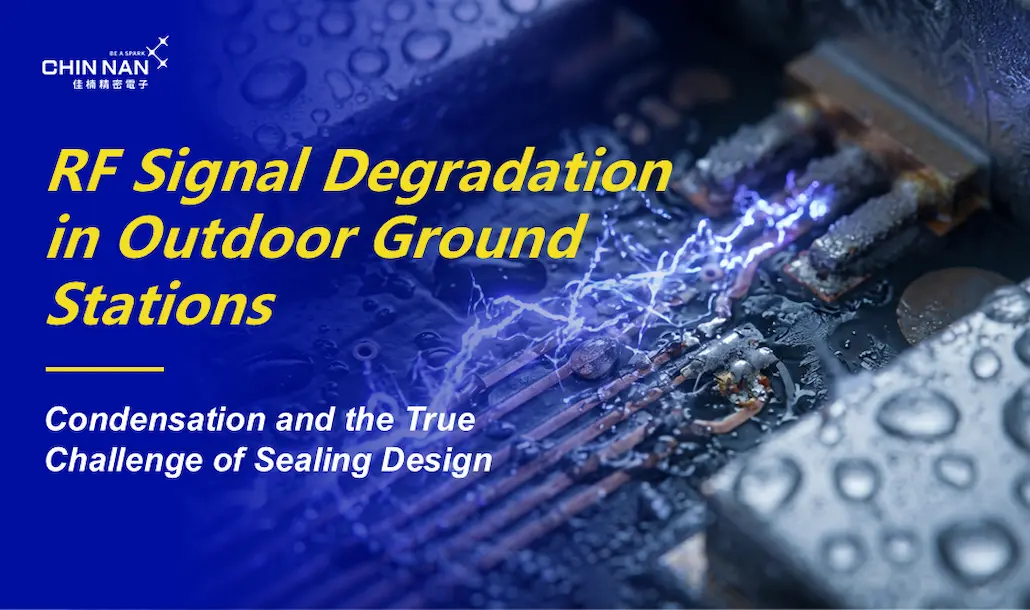
Outdoor equipment is exposed to condensation, rain, salt spray, and atmospheric pollutants. If connector material matching, plating thickness, or sealing design is insufficient, issues such as contact interface oxidation, galvanic corrosion, pitting and crevice corrosion, and fretting corrosion may occur, or moisture may seep into the cable braid or capillary gaps. Under high-frequency conditions, the Skin Effect concentrates current on the conductor surface. Surface roughness, oxides, and plating degradation increase conductor loss. Corrosion increases surface resistance, contact resistance, and interface non-linearity, leading to increased insertion loss, phase shift, intermodulation distortion, and decreased receiver sensitivity.

How Should RF Hardware for NTN Ground Stations be Selected?

Frequency ranges should be evaluated separately for Service Links and Feeder Links. Connector selection should be based on actual link frequency, power, loss, and environmental requirements:

  • SMA: Standard types are generally used below 18 GHz; high-frequency optimized types can extend to approximately 27 GHz.
  • 3.5 mm: Used for precision interconnects up to approximately 33 GHz.
  • 2.92 mm: Commonly used for K/Ka-band interconnects up to approximately 40 GHz.
  • 2.4 mm, 1.85 mm: Applicable for higher millimeter-wave frequencies.
  • N-Type, TNC, 7/16, or other interfaces: Applicable for lower frequency, high-power, or outdoor feeder systems.

Semi-Rigid and Phase-Stable Cable Assemblies

Semi-rigid cables, typically utilizing solid metal outer conductors, offer excellent shielding, dimensional stability, and repeatable formability. They are ideal for fixed paths within chassis, high-frequency modules, and phase-matched cable sets.

Comparison: Traditional Sub-6 GHz Base Stations vs. High-Frequency NTN Gateways


Swipe left or right to view full table

Specification & Environmental Factors

Traditional Sub-6GHz Ground Base Stations

High-Frequency NTN Gateways / Ka-Band Ground Stations

Recommended Design Strategies

Operating Frequency

Mostly below 6 GHz

System-dependent; feeder links may operate in Ku/Ka bands

Select SMA, 2.92 mm, waveguides, or other interfaces based on actual frequency requirements.

RF Insertion Loss

Lower frequencies allow for higher interconnect loss tolerances

Highly sensitive to conductor, dielectric, and interface losses at high frequencies

Minimize routing paths, reduce adapters/transitions, and conduct a comprehensive Link Budget analysis.

Return Loss

Depends on general system specifications

Requires stricter frequency-segmented control

Do not define VSWR ≤ 1.15 as a universal mandatory requirement across all broad bands.

Cable Assemblies

Flexible or corrugated coaxial cables are standard

Low-loss flexible, semi-rigid, waveguide, or phase-matched cable assemblies

Evaluate based on a combination of insertion loss, power handling, phase stability, and maintainability.

Waterproofing (Ingress Protection)

Typically IP65 - IP67

Outdoor interfaces may require IP67 or IP68

The specific immersion depth and duration for IP68 must be explicitly defined in the product specifications.

Hermetic Sealing Requirements

Generally module-dependent

Required for sealed bulkhead feedthroughs, nitrogen-filled modules, or pressure boundaries

IP ratings and hermetic leak testing must be specified and evaluated independently.

Corrosion Resistance

Site-dependent

Stricter requirements for coastal, offshore, and maritime sites

Explicitly specify base materials, plating, passivation, and post-salt-spray electrical performance acceptance criteria.

Maintenance Strategy

Personnel and equipment have easier access

Exorbitant maintenance costs at remote or unmanned sites

Adopt Fit-and-Forget interconnects, remote monitoring, and modular replacement designs.

Conclusion: High-Reliability RF Interconnects are Vital to NTN Infrastructure

The evolution of 5G NTN extends mobile communications from traditional terrestrial networks to satellites, HAPS, maritime, and remote areas. For ground stations, while RF connectors and cable assemblies are small, they directly impact link loss, return loss, phase stability, shielding effectiveness, and long-term environmental reliability. Chin Nan Precision Electronics provides high-frequency SMA, 2.92mm RF connectors, semi-rigid and customized coaxial cable assemblies, and integrated solutions featuring stainless steel, corrosion-resistant plating, and sealed structures. We assist clients in establishing verifiable, mass-producible, and long-term "Fit-and-Forget" RF interconnect solutions suitable for outdoor deployment.

5G NTN Key Technology FAQ

Q1: What is 5G NTN?

A: 5G Non-Terrestrial Network (NTN) is a communication technology that integrates non-terrestrial nodes—such as LEO, MEO, GEO satellites, and HAPS—into 3GPP standardized 5G network architectures to extend terrestrial coverage.


Q2: What role does the gNodeB play in satellite communications?

A: The gNodeB is the 5G base station responsible for radio resource management, protocol processing, and connection to the 5G Core Network. It can be deployed at the ground station (Transparent Payload) or on the satellite platform (Regenerative Payload).


Q3: Why do ground station connectors need to support frequencies above 27 GHz?

A: Because 5G NTN Feeder Links often utilize the Ka-band. RF interconnect components must support high-bandwidth operation to prevent impedance mismatch, VSWR rise, and signal degradation, ensuring link quality and satellite communication efficiency.


Explore the essential technologies for extreme 5G NTN environments >> High-Performance EMI Shielding | Shock & Vibration Resistance

CONSULT FORM

Consultation List

Review your selected inquiry items. You can switch inquiry topics using the buttons below.

DELETE

Delete this item

This action cannot be undone. Are you sure you want to delete?

Go Back

Confirm Deletion

SUBSCRIBE TO NEWSLETTER

Subscribe to Newsletter

歡迎訂閱佳楠電子報,我們將會與您分享最我們的最新動態、產品與技術訊息

Your Subscription Info

Go Back

Confirm Subscription

To unsubscribe, please

Click here

SUBSCRIBE SUCCESS

Successfully subscribed

您已成功訂閱佳楠電子報,敬啟期待我們的最新動態!

Return

CANCEL NEWSLETTER

Unsubscribe

請輸入您訂閱時所填寫的信箱,我們將協助您取消。

Your Subscription Info

Go Back

Confirm Cancellation

CANCEL SUCCESS

Subscription Cancelled

您的電子報已取消訂閱,期待您重新改變心意!

Return

WebsiteSearch

Site-wide Search

Search insights, key technologies, and products...

Search