01

JULY

2026

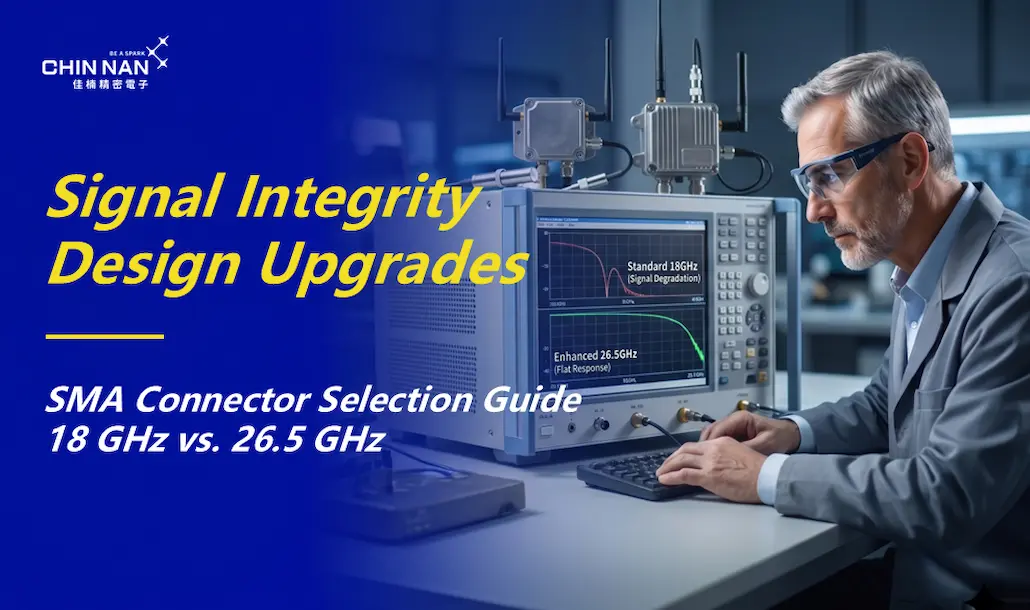
Is an 18GHz Spec Enough? 3 Design Upgrades in SMA Connectors to Ensure Signal Integrity in High-Frequency Applications

In the development of wireless communications, automated equipment, and radar systems, the SMA connector is the most common physical interface for hardware engineers, thanks to its high market penetration and mature geometric standards.


However, faced with standard "DC to 18GHz" specifications and high-frequency versions pushing "26.5GHz," how should engineers make the most cost-effective selection based on their project's actual operating frequency band? This article returns to the fundamentals of engineering physics to objectively analyze the design differences between these two SMA connector specifications, helping you find the perfect balance between system cost and Signal Integrity (SI).

1.The Design Blind Spot of the Standard 18GHz Operating Range: Challenges in Wi-Fi 6 and Drone Image Transmission

Standard commercial SMA connectors, with their 50Ω impedance matching and gold-plated contacts, are certainly capable of handling most LTE communication modules and traditional Wi-Fi equipment.


Imagine an industrial drone performing a high-altitude inspection mission; its core video transmission system typically operates between 2GHz and 6GHz. In this relatively "low-frequency" comfort zone, engineers seek a stable, low-insertion-loss, and vibration-resistant RF interface. However, even below 18GHz, if poor-quality connectors with excessive machining tolerances are used, the micro-contact failures caused by the drone's high-frequency vibrations will still trigger momentary electromagnetic interference (EMI). This can lead to fatal mosaic freezing and latency in the transmission feed.

2.Crossing the 26.5GHz Ultra-High Frequency Limit: The Severe Challenges of LEO Satellites and mmWave

With the explosive growth of 5G millimeter-wave (mmWave) and space communication technologies, the standard 18GHz can no longer satisfy the appetite of forward-looking applications.


For Low Earth Orbit (LEO) satellite ground stations deployed in extreme climates, their core phased array antennas must precisely handshake with high-speed satellites in space at Ka-band frequencies above 20GHz. In this "ultra-high-frequency deep water zone," signal wavelengths become extremely short. Even micrometer-level structural errors are magnified into severe Return Loss. If standard connectors are still used, the originally pure RF signals will hit an invisible wall, causing severe attenuation and reflection.

Swipe left or right to view full table

Feature

18GHz Standard SMA Connector

26.5GHz High-Performance SMA Connector

Target Operating Frequency Band

DC ~ 18GHz

DC ~ 26.5GHz (Backward compatible)

Voltage Standing Wave Ratio (VSWR)

1.15 ~ 1.30 (Varies by design)

1.15 @ 26.5GHz (Strictly controlled return loss)

Dielectric Material & Structure

Standard PTFE solid insulation

Aerospace-grade low-loss PTFE with an air dielectric / stepped structure to reduce equivalent dielectric constant at high frequencies.

Center Conductor & Shell Machining

Meets general MIL-STD-348 standard tolerances

Micrometer (μm) level CNC machining, ultimate control over concentricity and surface roughness to mitigate skin effect losses.

PCB Transition Impedance Design

Conventional 50Ω straight-through design

Proprietary Impedance Compensation structure to eliminate parasitic capacitance and inductance in the transition zone.

Signal Integrity (SI) Advantages

Meets most sub-6GHz wireless communication and general microwave measurement needs.

Purpose-built for LEO satellites and high-frequency radars, maintaining extremely low insertion loss and phase distortion.

Core Specifications & Design Metrics Comparison

To meet these extreme demands, high-performance RF connectors must break through the ceiling, extending the supported frequency up to 26.5GHz or even beyond 27GHz.

3.The Key to High-Frequency Success: The Invisible Foundation of Precision Manufacturing

Maintaining pure transmission in a 26.5GHz ultra-high-frequency environment severely tests the manufacturing foundation of a precision connector maker. High-performance SMA connectors typically feature three major design upgrades:


  • Premium Dielectric Material Selection: At high frequencies, traditional insulators become the main culprits of dielectric loss and insertion loss. Upgrading to high-grade PTFE (polytetrafluoroethylene) and other low-loss materials significantly reduces signal leakage, ensuring a stable high-frequency response.
  • Micrometer-Level Concentricity and Surface Roughness Defense: High-frequency signals are subject to the "skin effect," where current concentrates solely on the conductor's surface. This relies on the manufacturer's ultimate CNC machining technology to ensure absolute precision at the mating contacts of the male and female connectors, avoiding signal reflections caused by eccentric microscopic unevenness.
  • Seamless Impedance Continuation Structure: The transition from the connector's tail end to the PCB board is a disaster zone for high-frequency distortion. An optimized contact structure allows the 50Ω impedance to transition seamlessly, maximizing the performance of test instruments or end equipment.

Conclusion: Choosing the Right Frequency Range to Build a High-Reliability Hardware Defense

The frequency range is not just a number; it is the critical strategic metric that determines whether end equipment can survive on the high-frequency battlefield. Accurately selecting an 18GHz or 26.5GHz grade high-performance connector based on the application scenario is a design strategy every R&D professional must master.


As a professional connector manufacturer with over 60 years of experience, Chin Nan Precision provides a variety of standard and high-frequency RF connectors to build the most solid physical transmission layer for your advanced equipment. Are you looking for a high-performance solution with extreme Signal Integrity for your next high-frequency project? Contact Chin Nan's professional technical team today for exclusive selection advice!


Frequently Asked Questions (FAQ)

Q1: Under what circumstances must I upgrade from a standard 18GHz to a 26.5GHz SMA connector?

A: If your application operates below 18GHz (like most LTE communications and traditional Wi-Fi), a standard SMA connector is sufficient. However, if your project involves 5G mmWave, the Ka-band of Low Earth Orbit (LEO) satellites, or drone environments with high-frequency vibrations that strictly demand "Signal Integrity," minor structural errors will be magnified into severe return loss. In these cases, upgrading to a 26.5GHz high-frequency connector is strongly recommended to ensure stable high-frequency response.


Q2: Why do SMA connectors with the same appearance have vastly different transmission performances in high-frequency environments?

A: The key to high-frequency success lies in the "precision manufacturing craftsmanship" invisible to the naked eye. Because high-frequency signals exhibit the skin effect, microscopic unevenness in poor-quality connectors triggers signal reflection. High-performance SMA connectors overcome this through three upgrades: utilizing low-loss PTFE dielectric materials, precise CNC machining, and seamless 50Ω impedance continuation at the transition joint, significantly reducing signal loss.


Q3: Does Chin Nan provide SMA connector solutions for special high-frequency projects?

A: Yes. As an RF connector brand with over 60 years of experience, we provide not only highly popular 18GHz standard products but also high-performance RF connector solutions reaching 26.5GHz and beyond for forward-looking applications like automated equipment, drone video transmission, and space communications. R&D personnel are welcome to contact our technical team anytime for exclusive hardware defense selection advice.


CONSULT FORM

Consultation List

Review your selected inquiry items. You can switch inquiry topics using the buttons below.

DELETE

Delete this item

This action cannot be undone. Are you sure you want to delete?

Go Back

Confirm Deletion

SUBSCRIBE TO NEWSLETTER

Subscribe to Newsletter

歡迎訂閱佳楠電子報,我們將會與您分享最我們的最新動態、產品與技術訊息

Your Subscription Info

Go Back

Confirm Subscription

To unsubscribe, please

Click here

SUBSCRIBE SUCCESS

Successfully subscribed

您已成功訂閱佳楠電子報,敬啟期待我們的最新動態!

Return

CANCEL NEWSLETTER

Unsubscribe

請輸入您訂閱時所填寫的信箱,我們將協助您取消。

Your Subscription Info

Go Back

Confirm Cancellation

CANCEL SUCCESS

Subscription Cancelled

您的電子報已取消訂閱,期待您重新改變心意!

Return

WebsiteSearch

Site-wide Search

Search insights, key technologies, and products...

Search