


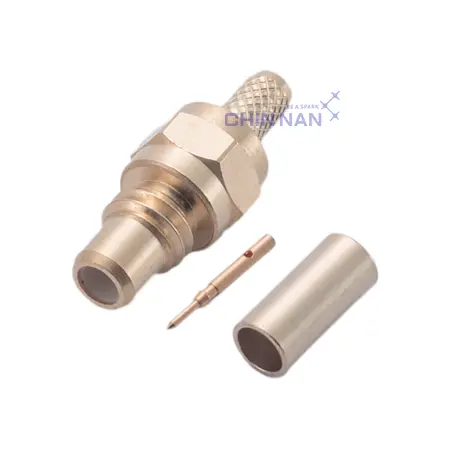
The SMC Straight Jack Crimp for RG174, RG316, RG188, LMR100 Cable is purposefully designed for high-performance cable applications, making it highly suitable for RG174U, RG316U, RG188, and LMR100 coaxial cables. This premium SMC jack connector ensures outstanding RF signal transmission within a 50 Ω impedance system across a broad frequency range of 0 to 10 GHz.
Featuring an optimized Voltage Standing Wave Ratio of 1.32 MAX at 3 GHz, 1.44 MAX at 6 GHz, and 1.6 MAX at 10 GHz, along with a low insertion loss of 0.25 dB max. at 4 GHz, this SMC RF connector minimizes signal degradation to guarantee superior signal integrity. Coupled with a robust power handling capacity of 220W, it is highly adaptable to a wide variety of high-frequency and microwave application scenarios.
To ensure long-lasting durability and reliability in industrial environments, our SMC connector is constructed with a robust brass body and a precision-engineered brass center contact. The integration of high-grade PTFE insulation enhances electrical stability, enabling the connector to operate reliably in extreme environmental temperatures ranging from -65°C to 165°C. Designed for easy installation and efficient maintenance, the center contact is seamlessly assembled to the cable's inner conductor via soldering, while the ferrule is securely crimped onto the outer shield of the cable. It offers a mating durability of 500 cycles, supported by a minimum cable retention force of 15 lbs and an axial center contact retention of 4 lbs, ensuring both mechanical stability and consistent signal delivery.
In terms of electrical safety and environmental resilience, this RF coaxial connector holds a continuous voltage rating of 335 volts rms at sea level and a dielectric withstanding voltage of 1000 volts rms at sea level. The insulation resistance is rated at a minimum of 1000 Megohms, with the contact resistance strictly controlled at a maximum of 6.0 Milliohms for the center contact and 1.0 Milliohms for the outer contact. Furthermore, it strictly complies with military standards, passing the MIL-STD-202 Method 204 Test Condition D for vibration and MIL-STD-202 Method 101 Test Condition B for salt spray, ensuring exceptional operational integrity even in harsh and corrosive environments.