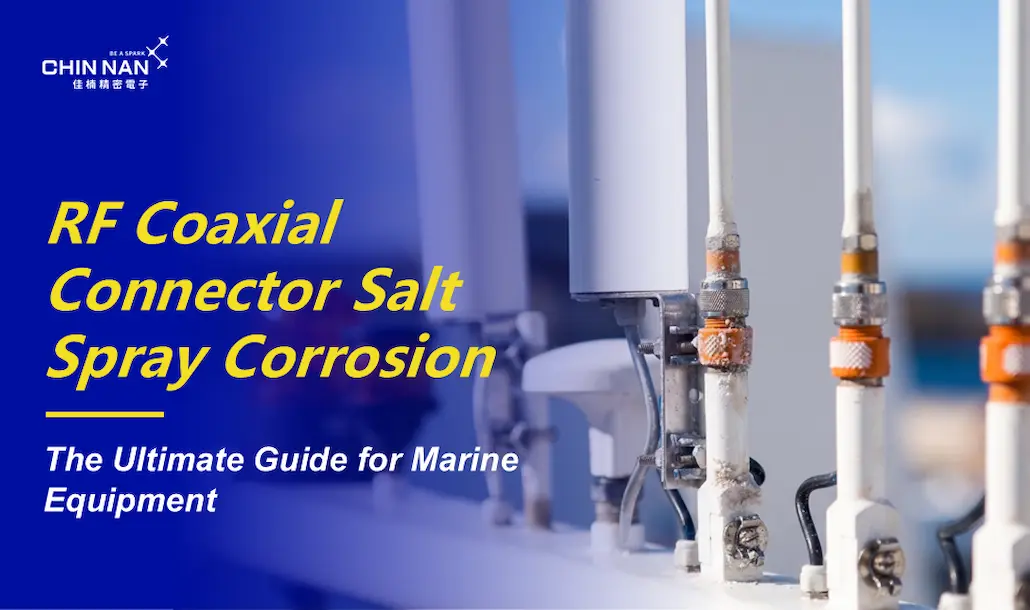
Q1: How should I choose between Water-Resistant and Waterproof connectors?
A: The core of the selection process lies in the "exposure environment." If the connector is installed in sheltered areas like the bridge or sealed internal cabins, a Water-Resistant (IP65/66) rating is usually sufficient. If the equipment will be installed on open decks, ship sides, or directly exposed to crashing waves, you must specify a Waterproof connector with a Long-Term Immersion Depth IP68 rating to prevent seawater from penetrating the cable interface via capillary action.
Q2: My connector is IP68 rated, so why is it still rusting and corroding?
A: This is a common misconception. IP68 specifies "water ingress protection," not the "corrosion resistance" of the metal itself. If you select a low-cost Nickel-plated connector, the high chloride ions in sea fog will quickly trigger galvanic corrosion once the plating is slightly compromised. We highly recommend using White Bronze (Tri-metal) plating or Stainless Steel to fundamentally resolve corrosion issues.
Q3: Under what circumstances do I need to upgrade to "Hermetic" connectors?
A: If your project involves deep-sea pressure (e.g., ROVs), requires a zero-humidity internal instrument environment, or applies to high-precision military vacuum equipment, you must use Hermetic connectors. They utilize Glass-to-Metal Sintering to permanently bond metal and glass molecules, forming a molecular-level barrier far more reliable than traditional O-rings.
Q4: Why is White Bronze (Tri-metal) strongly recommended over traditional Nickel for marine communications?
A: White Bronze offers three major advantages: First, exceptional chemical corrosion resistance, significantly increasing salt spray test survival hours. Second, its "non-magnetic" property effectively suppresses intermodulation distortion (Low PIM) common in RF systems. Finally, its high hardness and wear resistance make it perfect for environments subjected to constant vibration.
Q5: Is unstable shipborne equipment signal related to the connectors?
A: Absolutely. When a connector suffers from oxidation, salt crystal accumulation, or vibration-induced loosening due to harsh environments, the immediate degrading metric is the Voltage Standing Wave Ratio (VSWR). We recommend inspecting the RF interface for corrosion and ensuring the connector features an adequate threaded locking mechanism to maintain stable electrical contact during violent sea states.
>> Overcoming RF Coaxial Connector Salt Spray Corrosion: The Ultimate Guide for Marine Equipment
Want to explore how physical structures completely resolve leakage and corrosion? Discover the Key Technologies Behind Waterproof & Hermetic RF Connectors >> Learn More